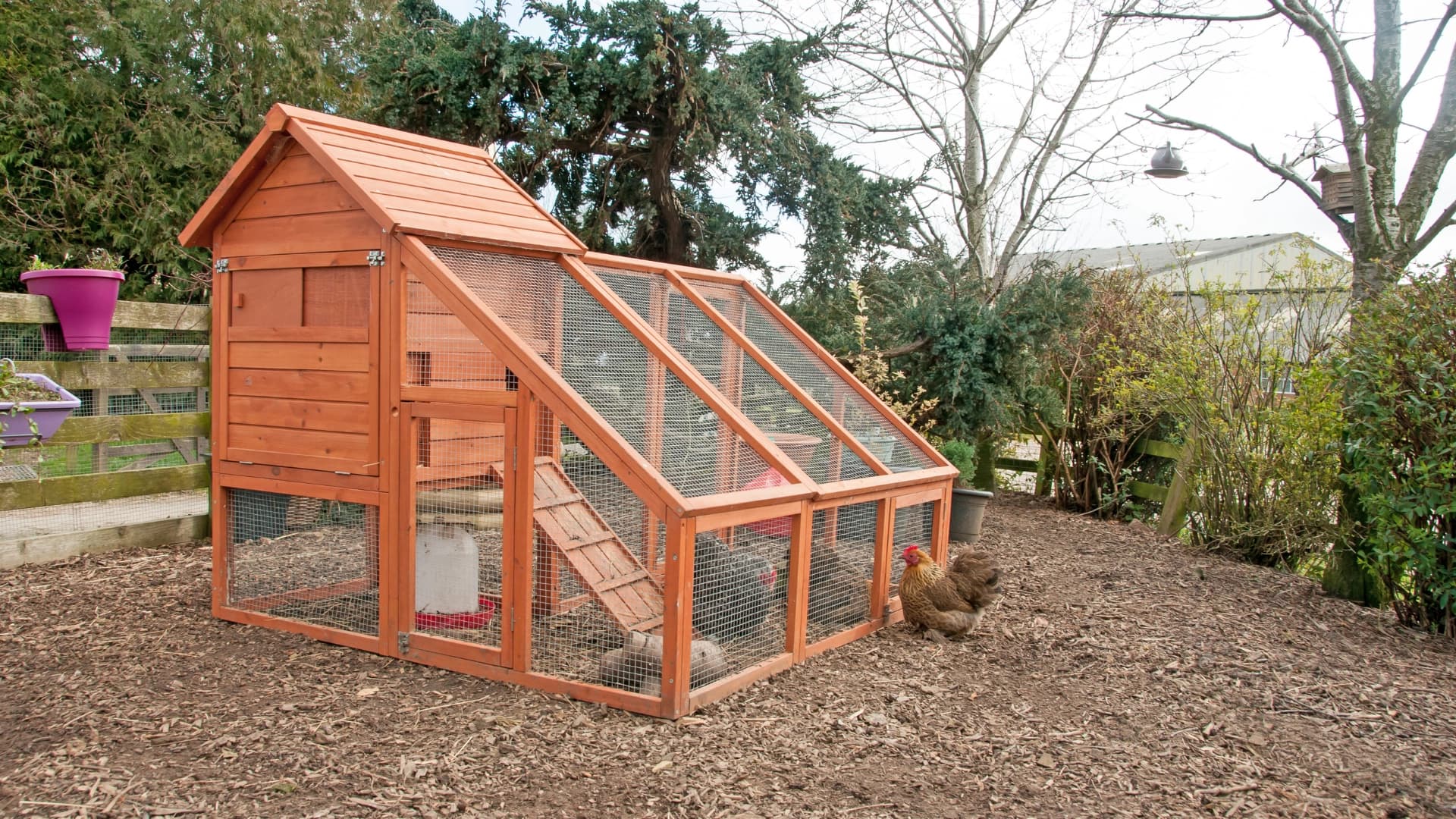
2026 Australian Chicken Coop Design: The Fox-Proof & Climate-Ready Standard
A good coop isn't just shelter—it's a fortress against predators and a refuge from Australian extremes.
Built around the nationally endorsed Australian Animal Welfare Standards and Guidelines for Poultry, including perching and scratch areas.
Quick Tools — Jump To
Many first-time chicken owners unknowingly make design mistakes that lead to predator attacks, overheating, snake problems, overcrowding, and poor outdoor conditions.
The good news is: these problems are easy to avoid if your coop is designed properly from the start.
The design principles below don't just show you how to build a great coop — they also prevent the most common chicken coop design mistakes beginners make in Australia.
This Page Is For You If:
- You are building your first chicken coop
- You want to avoid fox, snake, and heat disasters
- You want a coop that works in Australian conditions
- You don't want to rebuild it later
If you follow this guide, you'll avoid the 5 mistakes that cause most backyard chicken problems.
Coop Design Dashboard
Quick-check your setup before diving into the detailed guides below.
Run Size Quick-Check
Coop Castle RecommendationSecurity Essentials
The Aussie Flock-to-Space Master Tool
Instantly size your coop (0.4 m²/bird), run (1 m²/bird), and nesting boxes — using Coop Castle's practical backyard flock recommendations.
Prefer a standalone calculator? Try our dedicated Chicken Coop Size Calculator →
Backyard Poultry Planner
Plan your flock in two clicks — size your coop & run, then find the right Aussie breed.
Tropical/high-heat climates get a larger comfort allowance (0.5 m²/bird) on top of the 0.4 m²/bird standard, to reduce heat stress.
1.6 m²
0.4 m² / bird (recommended starting point)
4 m²
1 m² / bird
Total Minimum Land Area
5.6 m²
Each chicken needs at least 1 m² of outdoor run space and 0.4 m² of indoor coop space — Coop Castle's recommended starting point for backyard flocks (not a universal legal minimum; requirements vary by state, territory and council).
Overcrowded runs lead to bullying, feather pecking, stress, and disease. Use this calculator to check your run meets the standard.
Your Details
Results
Enter the number of chickens to see results.
Quick Examples
Why Space Prevents Problems
Chickens with enough space can escape bullies, establish pecking order naturally, and find their own food through foraging. Crowded birds have nowhere to go, leading to stress, pecking, and disease outbreaks.
The golden ratio is 1 nesting box per 4 hens. Chickens naturally share boxes and take turns — you don't need one each.
Too many boxes wastes space; too few causes crowding and egg breakage.
Your Details
Results
Enter the number of hens to see results.
Quick Examples
Chickens Share Naturally
Don't worry if all your hens use the same box — this is normal flock behaviour. Having the right number of boxes available is what matters, even if they have a favourite.
Welfare Standards Note
Coop Castle's recommended starting point is 1m² of clear run space per bird, along with the 1:7 Nest Box Rule and 6 hours of darkness guidance drawn from the nationally endorsed Australian Animal Welfare Standards and Guidelines for Poultry. Our calculators above are pre-set to these recommendations to help keep your flock healthy and stress-free. Animal welfare and poultry-keeping requirements vary between Australian states, territories and local councils, so confirm the specific rules that apply where you live.
Read the Welfare Standards GuideRoosting Bar Guide: Correct Height & Spacing
Get the roost right and your chickens will sleep soundly
Each bird needs 20–25 cm of roosting bar length. Chickens huddle in winter but spread out in summer — provide slightly more than the minimum.
Multiple roosts at the same height work well. Avoid stacking roosts directly above each other (lower birds get pooped on!).
Your Details
Results
Enter the number of birds to see results.
Quick Examples
Chickens Sleeping in Nest Boxes?
This usually means the roost is too low, too narrow, or young birds haven't learned yet.
Fix: Make roosts higher than nesting boxes, use flat-topped bars (5–10 cm wide), and gently place birds on the roost at dusk for a few nights until they learn.
Advanced Chicken Coop Planning Tools
Fine-tune your coop design for Australian conditions
These extra planning tools help fine-tune your coop design for Australian conditions, covering ventilation, nesting, and predator protection.
Coop Ventilation Calculator (Australia)
How much ventilation does your chicken coop really need?
Good ventilation removes moisture, ammonia, and excess heat. In Australian conditions, more ventilation is almost always better — the key is placement, not restriction.
This calculator provides a conservative starting point. Adjust upward for extreme heat regions.
Your Details
Results
Enter your coop floor area and chicken count to see results.
Avoid Drafts on Roosts
Ventilation should move air above and around the birds — not blow directly onto roosting chickens. Keep low-level openings away from roost bars, especially in cooler months.
Predator-Proof Mesh Estimator (Australia)
Estimate the mesh you need to protect your flock from foxes, snakes, and rodents
Foxes, snakes, and rodents are the main predator threats in Australian backyards. Proper mesh selection and coverage is the most important security decision you'll make.
This tool estimates the mesh area you'll need for walls, roof, and a dig-proof apron.
Run Dimensions
Mesh buried 30 cm underground around the perimeter to stop digging predators.
Estimated Mesh Required
Enter your run dimensions and fence height to see results.
Chicken Wire Is Not Predator-Proof
Chicken wire (hex netting) keeps chickens in but does not stop foxes, dogs, or determined predators. Always use welded steel mesh for security. This is the single most common mistake in Australian coop builds.
Raising the Coop: Why Ground Clearance Matters in Australia
One of the most overlooked design choices — with multiple benefits
Raising a chicken coop off the ground is one of the most overlooked design choices in Australian backyards — yet it solves multiple problems at once.
Ground-level coops trap heat, moisture, and pests. A raised coop improves airflow, hygiene, and comfort, especially in hot or humid conditions.
Better Airflow and Cooling
Heat builds up quickly in coops that sit directly on the ground. When a coop is raised, air can move freely under and through the structure, allowing hot air to escape instead of being trapped.
This improves cooling in summer and reduces heat stress — one of the biggest risks for backyard chickens in Australia.
Reduced Moisture, Smell, and Disease
Moisture is a major cause of ammonia smell, flies, and bacterial growth.
A raised coop:
- stays drier after rain
- reduces damp bedding
- lowers ammonia buildup
Dry conditions help reduce respiratory issues and parasites.
Fewer Pests and Hiding Spots
Raising the coop helps reduce:
- rodents nesting underneath
- snakes using ground cover to hide
- insects breeding in damp soil
Raising the coop does not replace predator-proof mesh, but it removes many conditions pests rely on.
Natural Shade and Comfort
In hot weather, chickens instinctively rest in shaded, breezy areas.
A raised coop creates:
- a shaded resting area underneath
- cooler ground temperatures
- a comfortable daytime shelter
Many chickens will rest under a raised coop during summer even if they sleep elsewhere.
How High Should a Chicken Coop Be?
For most Australian backyards:
| Clearance Type | Recommended Height |
|---|---|
| Minimum clearance | 30–45 cm |
| Ideal clearance | 45–60 cm |
This provides airflow and shade without making cleaning or egg collection difficult.
Safety Notes
If you raise your coop:
- ensure legs are solid and stable
- anchor the structure so it cannot tip
- fully enclose the run with predator-proof mesh
Raising the coop improves conditions, but security must remain a priority.
Sand vs Straw (Deep Litter): What's the Best Coop Bedding?
Both have pros and cons—choose based on your climate and setup
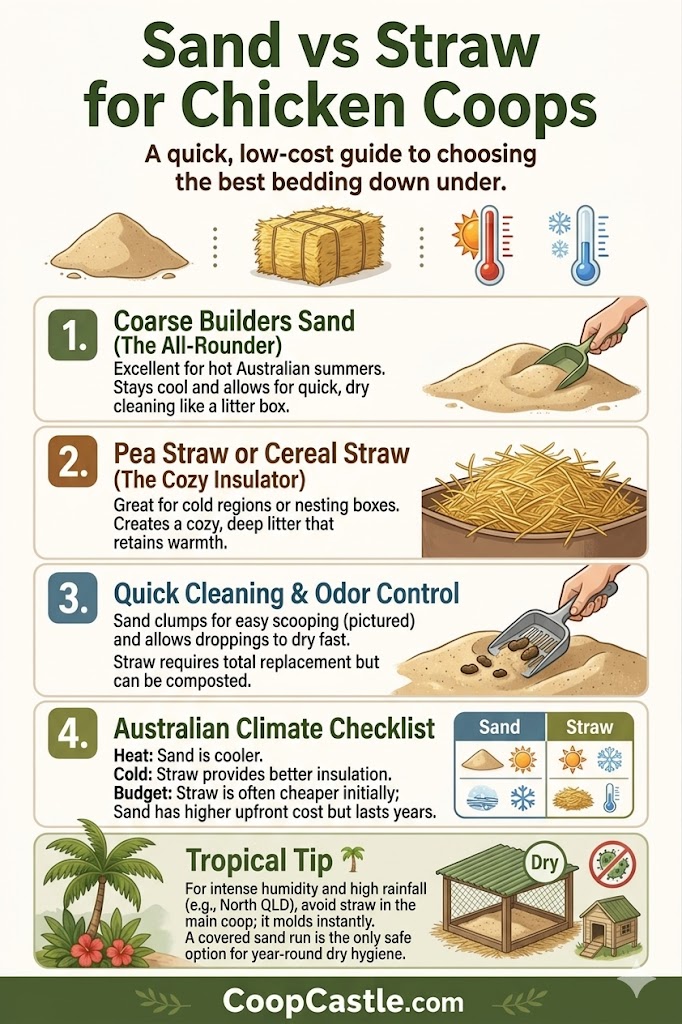
Choosing the best bedding down under comes down to your climate and setup:
🏖️ Sand Bedding
Pros
- • Easy to scoop (like cat litter)
- • Dries quickly—less smell
- • Stays cool in summer heat
- • Lasts for years if maintained
- • Natural dust bath material
Cons
- • Heavy to install initially
- • Can get cold in winter
- • Must use coarse construction sand
- • Requires scooping every few days
🌾 Straw / Hemp (Deep Litter)
Pros
- • Warm and insulating in winter
- • Composts into rich fertiliser
- • Lower initial setup cost
- • Deep litter method reduces cleaning
- • Natural and absorbent
Cons
- • Can harbour mites if damp
- • Holds moisture—can smell
- • Needs full replacement periodically
- • Can get too hot in summer
Quick Comparison
| Factor | Sand | Straw/Hemp |
|---|---|---|
| Hot climate | ✓ Better | Can overheat |
| Cold climate | Gets cold | ✓ Better |
| Odour control | ✓ Better | Needs management |
| Maintenance | Scoop regularly | Add layers, replace |
| Initial cost | Higher | Lower |
Best Choice for Hot Australian Climates
Sand is generally better in hot Australian summers. It stays cool, dries quickly, and doesn't harbour moisture that leads to ammonia and flies. If you live in a cooler area like Tasmania or the highlands, deep litter may work better for winter warmth.
The 5 Most Common Chicken Coop Design Mistakes
Most beginner coops fail because of one or more of these five design mistakes:
Quick Overview
| Mistake | Consequence |
|---|---|
| Using chicken wire or weak security | Leads to fox attacks and losses |
| Not snake-proofing lower sections | Leads to egg and chick losses |
| Poor ventilation | Leads to heat stress and deaths in summer |
| Not allowing enough space per bird | Leads to stress, pecking, and disease |
| No shade or dust bath in the run | Leads to overheating and parasite problems |
Each section below explains the correct design approach that prevents these problems.
Related Coop Design Guides
Free-ranging is a bonus, not a replacement for properly sized coop and run space.
Smelly Chicken Coop? It's a Warning SignPersistent coop odour usually points to ventilation, moisture or bedding problems that are easy to fix.
Why Chickens Refuse to Sleep in the CoopChickens avoiding the coop at night usually comes down to roost height, parasites or layout issues.
Why Most Beginner Coops Are Built Wrong
Most people copy:
- Overseas plans (not designed for Australian heat or predators)
- Cheap YouTube builds
- "Looks good" designs instead of function-first designs
The result is usually:
- Fox or snake losses
- Overheated birds
- Stressed, unhealthy flocks
- Or having to rebuild the coop within a year
Good coop design isn't about looks. It's about survival, comfort, and long-term practicality.
Superior Plastic Coops vs. Timber: Choosing the Right Material
Choosing the right material for Australian conditions
♻️ Heavy-Duty Recycled Plastic Coops
- 100% mite-proof — mites can't hide in the grain
- UV-stabilised for the Aussie sun
- Can be hosed out in minutes
🪵 Timber Coops
- Better natural insulation in extreme cold
- Easily customisable to any design
- Widely available and repairable
Are Plastic Chicken Coops Good for Australia?
Not all plastic is created equal. Most beginner 'plastic coops' fail in Australia because they are made of thin, single-walled material that warps in the sun and lacks ventilation.
However, Professional-Grade Recycled Plastic (like UV-stabilized 9mm panels) is a different story. These high-end coops are a superior long-term investment for high-humidity areas because they are 100% mite-proof and won't rot.
The CoopCastle Rule: If you go plastic, it MUST be heavy-duty recycled material and it MUST have added ventilation. If you are on a budget, a well-built Timber Coop remains the safest and most reliable choice for the Australian climate.
Plastic Chicken Coops: What Beginners Get Wrong in Australia
Many beginner chicken coops sold in Australia are lightweight plastic designs originally developed for cooler overseas climates.
While they are often marketed as easy to clean and low maintenance, they can struggle in real Australian backyard conditions.
Common limitations of plastic chicken coops include:
- Poor airflow, which can cause dangerous heat build-up in summer
- Condensation and trapped moisture, increasing ammonia smell
- Lightweight panels or doors that foxes can damage or force open
- Gaps large enough for snakes, rodents, or chicks to enter or escape
- Limited internal and run space, leading to overcrowding and stress
Plastic coops are not always unsafe, but they often require significant modification—such as added ventilation, shade, and reinforced mesh—to perform reliably in hot, predator-heavy regions of Australia.
This is why function-first coop design matters more than materials alone. A well-designed timber or mixed-material coop with proper airflow, predator protection, and adequate space will generally perform better long-term in Australian conditions.
The CoopCastle Safety Standard
The 1.6mm Rule: Why 'Chicken Wire' is a Death Sentence
Never use standard 'Chicken Wire' (hexagonal wire). It keeps chickens in, but it does NOT keep predators out. For a fox-proof fortress, you must use 1.6mm welded steel mesh with maximum 12.5mm × 12.5mm openings.
🌴 Local Tip: In North Queensland, this isn't just for foxes—it's your primary defence against pythons and goannas.
2026 Security Spec Table
| Material | Gauge | Fox Resistance | Status |
|---|---|---|---|
| Standard Chicken Wire | 0.7–1.0mm | None — easily bitten through | ✕ UNSAFE |
| Light Hardware Cloth | 1.0–1.2mm | Partial — may resist smaller predators | ⚠ RISKY |
| CoopCastle 1.6mm Welded Steel | 1.6mm+ | Full — teeth and claw proof | 🛡️ FORTRESS GRADENational Standard |
Pro Tip: If you can bend the wire easily with two fingers, a fox can bite through it in 60 seconds. Don't risk the chew-test with your flock.
The Fortress Method
Fox-proofing is the single most important aspect of coop design in Australia
✅ Prevents Mistake #1: Using chicken wire or weak security
Use This
1.6mm Welded Steel Mesh
Strong enough to resist fox teeth and claws. The only reliable option for Australian conditions.
Buried Apron or Hardware Cloth
Extend mesh 30cm outward and bury it. Foxes dig, so your defences must go underground.
Secure Locks
Use proper latches foxes can't flip open. Carabiners or padlocks on all doors.
Not This
Chicken Wire
Designed to keep chickens IN, not predators OUT. A determined fox will tear through it in minutes.
Gaps Larger Than 25mm
Foxes can squeeze through surprisingly small spaces. Check every corner and joint.
Unsecured Pop Holes
An open door at night is an invitation. Always lock up before dusk without fail.
✅ Prevents Mistake #2: Not snake-proofing lower sections
Snake Proofing
Standard mesh keeps foxes out but snakes can still enter through larger gaps. For snake-prone areas, use 10mm x 10mm mesh (sometimes called hardware cloth) on lower sections of your coop. Snakes are attracted by eggs and chicks, so extra protection is essential in warmer months.
Ventilation for Aussie Heat
Chickens don't sweat—proper airflow is their only cooling mechanism
💨 Why Your Coop Smells (It's Not The Poop)
If your coop stinks, it's probably not the droppings—it's the moisture and trapped ammonia. Chickens don't sweat, so airflow is everything. Without ventilation, hot, humid air builds up fast, especially in Aussie summers.
✅ Fix: Vent at the top, airflow across the coop, no drafts near the floor.
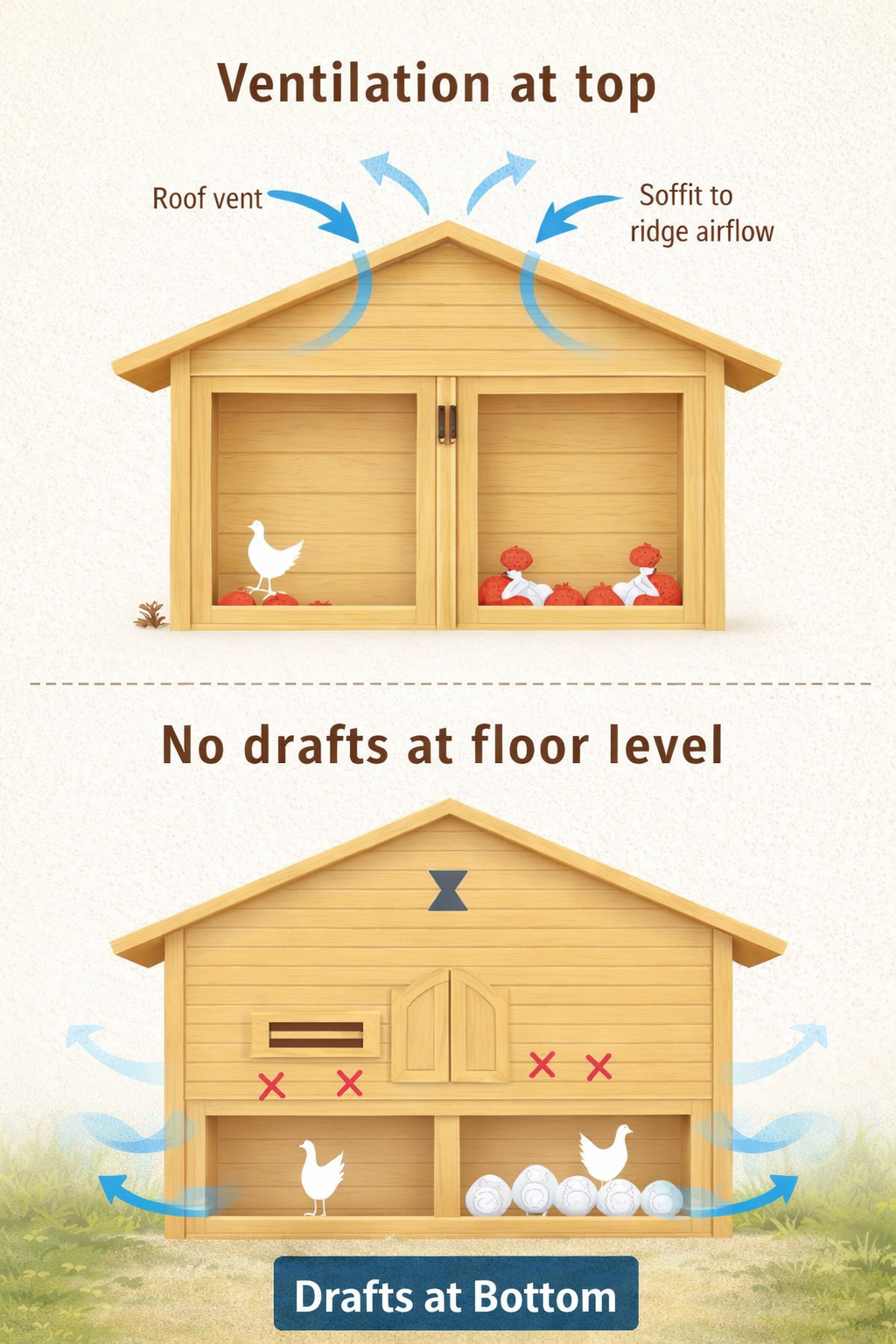
✅ Prevents Mistake #3: Poor ventilation
Ridge Vents
Hot air rises—let it escape through vents at the roof peak. Essential for Australian summers.
Cross-Breezes
Position openings on opposite walls to create airflow. Cover with mesh for security.
Covered Openings
Use overlapping boards or angled covers to keep rain out while allowing air movement.
Pro Tip: The Hand Test
In summer, put your hand inside the coop at midday. If it feels stuffy or uncomfortably warm to you, it's dangerously hot for your birds. Aim for airflow you can feel but not drafts that blow directly on roosting areas.
🌴 Tropical Tip
In North QLD, ridge vents are non-negotiable. You need a 'Chimney Effect' to pull hot air out the top so cooler air can be drawn in from the bottom.
🌏 Climate Zone Ventilation Guide
🌴 Tropical / Northern
QLD, NT, Northern WA
- Increase vent openings by 50% above standard
- Ridge vents are non-negotiable — use the chimney effect
- Open-sided runs with shade cloth for humidity control
- Sand bedding preferred — dries fast, stays cool
❄️ Temperate / Southern
VIC, TAS, SA, Southern NSW, ACT
- Standard vent openings (5% of floor area) are sufficient
- Use adjustable vents — open in summer, reduce in winter
- Deep litter (straw/hemp) adds warmth on cold nights
- Avoid sealing the coop — condensation causes more harm than cold
Space Requirements
More space means healthier, happier birds with fewer behavioural problems
✅ Prevents Mistake #4: Not allowing enough space per bird
Inside the Coop
- 0.4m² per bird minimum floor space
- 25cm roosting bar space per bird
- 1 nesting box per 3-4 hens
🥚 The Golden Ratio: 1 Nesting Box per 4 Hens
Chickens don't need a box each—they take turns. But overcrowding still causes broken eggs, bullying, and hens sleeping where they shouldn't. Stick to the sweet spot: 1 box for every 3–4 hens.
❌ Too many hens = not enough space = bad habits fast.
The Run (Outdoor)
- 1m² per bird minimum (more is always better)
- ✅ Prevents Mistake #5: No shade or dust bath in the run
- Shade is essential—natural or built
- Dust bath area for parasite control
Choosing the right birds for your space? See our 2026 Breed Heat-Tolerance Matrix.
Shade & Sun Protection in Australian Chicken Runs
Shade is not optional in Australian backyards. Chickens can overheat from direct sun exposure even when water and ventilation are available.
Every chicken run should include at least one area that remains shaded during the hottest part of the day. Natural shade from trees, solid roofing, or 70–90% shade cloth all work well.
Do not rely on coop shade alone — chickens spend most daytime hours in the run. Shade should be combined with good airflow to allow birds to cool themselves effectively.
Lack of shade increases heat stress, aggressive behaviour, and parasite pressure, even in otherwise well-designed coops.
Chicken Coop Size Calculator (Simple Math)
To calculate how much space your chickens need:
Coop size = number of chickens × 0.4 m²
Run size = number of chickens × 1 m²
Quick Examples
- 3 chickens → 1.2 m² coop + 3 m² run
- 4 chickens → 1.6 m² coop + 4 m² run
- 6 chickens → 2.4 m² coop + 6 m² run
- 10 chickens → 4.0 m² coop + 10 m² run
Quick Reference Table
| Chickens | Coop Size | Run Size |
|---|---|---|
| 3 | 1.2 m² | 3 m² |
| 4 | 1.6 m² | 4 m² |
| 6 | 2.4 m² | 6 m² |
| 8 | 3.2 m² | 8 m² |
| 10 | 4.0 m² | 10 m² |
Important
Many commercial "4–6 chicken" coops only meet bare minimums. Bigger is always better for health and behaviour.
Why Good Coop Design Prevents Most Beginner Mistakes
Most chicken problems come from design mistakes, not bad luck. Predator attacks, heat stress, snake incidents, and behavioural issues are almost always preventable.
If you follow the design principles on this page, you automatically avoid the most common beginner errors before they ever happen.
The Simple Beginner Rule
A good chicken coop in Australia must be:
- Strong enough to stop foxes
- Tight enough to stop snakes
- Open enough to release heat
- Big enough to prevent stress
- Shaded enough to prevent overheating
If your coop does those five things, you've already avoided most beginner mistakes.
🏰 Fortress Grade Checklist
0/5 completed
Common Beginner Questions
Is chicken wire ever OK?
No. Chicken wire is only for keeping chickens in, not predators out.
Do I really need snake mesh?
If you are in warm or rural areas, yes — especially for chicks and eggs.
Can a coop have too much ventilation?
No, as long as there are no direct drafts on roosting birds.
Is bigger always better?
Yes. More space always reduces stress and disease.